

Your Mind is So Open, It’s Closed: Watching 'Eureka Day' as an Ex-Teacher
Theater | Eureka Day by Johnathan Spector

In December 2021, I sat in tears on my couch drafting an email to my boss. One of those emails you aren’t supposed to send. I reread it over and over and over again, softening expletives and sharpening my back-up points. The language was biting. My tone, angry and resolved. Just the thought of rereading that letter gives me a stomach ache. I revised each sentence until it oozed with the resentment, exhaustion, and guilt that I felt. Then, I hit send.
I regret the way I did it, but I don’t regret leaving the classroom. The more professional version of that email might have simply said: I am not renewing my contract for the 2022-2023 academic year. And I didn’t. I went back to work in January knowing the next six months would be my last as a high school English teacher. Given the state of school culture today, I doubt I will ever go back.
Then visiting Boston last week, I did revisit the classroom on Tuesday night at the Huntington Theater, where I saw Johnathan Spector’s Eureka Day. Nothing has captured my experience working in education better than this play. I recognized the exhausting, overwrought conversations: the self-interested “consensus decision-making” posturing as an argument for community or equity or open-mindedness; the way technology can fuel a tragedy of the commons, if that commons were a school leader’s emotional and mental bandwidth. At the heart of it, I saw the awkward blend of liberal ideals, entitlement, and power that ultimately led me to give up on a career I genuinely loved.
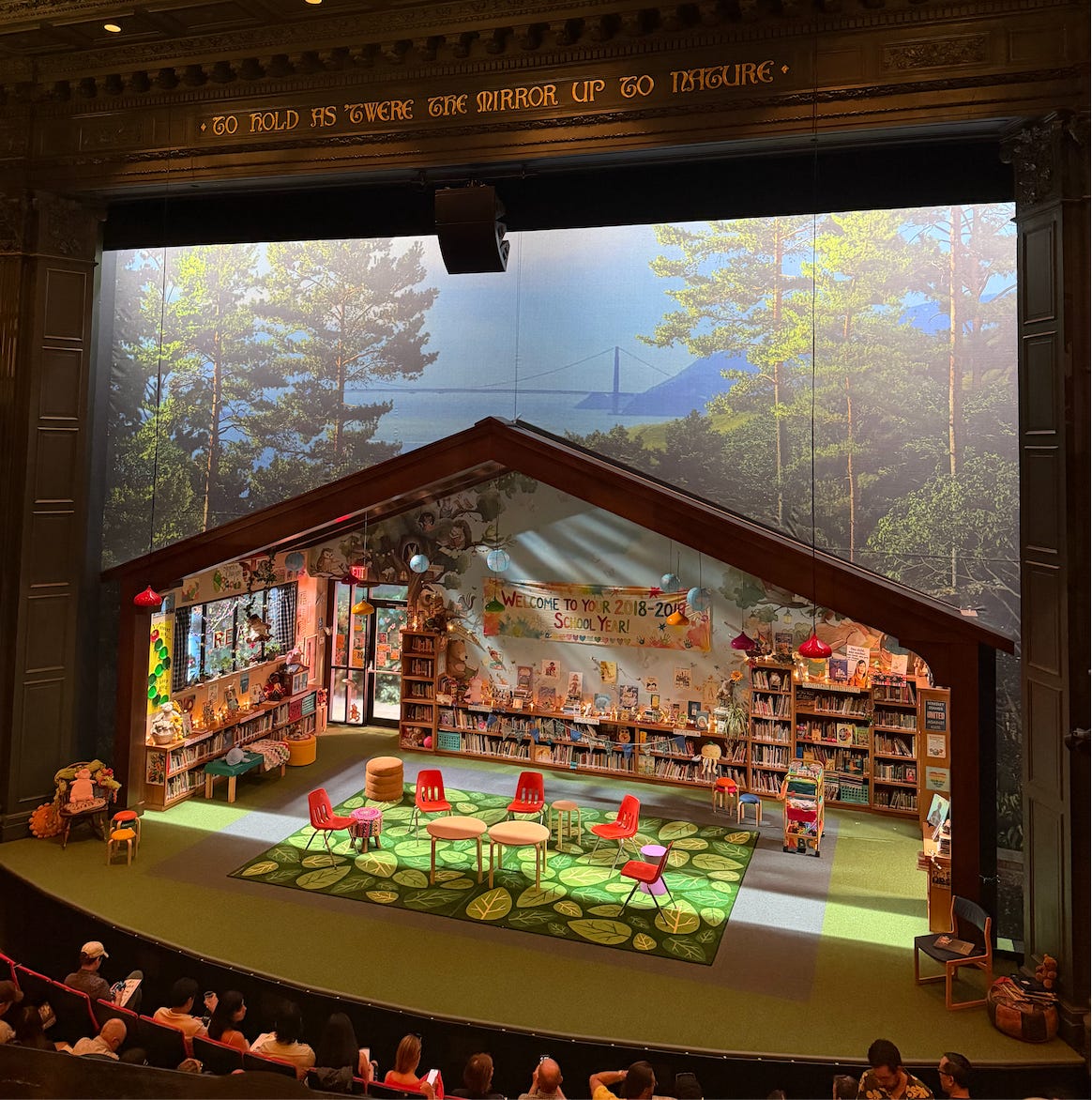
The entire production is set in a private elementary school classroom in the Berkley Hills, roughly 20 miles from where I live in San Francisco. In the first scene, the Executive Committee—a group of four well-meaning parents and a clownish head of school named Don—has gathered to kick-off the 2018-2019 school year at Eureka Day Elementary.
MEIKO
personally no
I don’t find it offensive
the term itself is not offensive
ELI
(Helpfully.)
it’s descriptive
SUZANNE
I think she’s saying
I’m not putting words in your mouth
she’s saying it’s not offensive
but when you contextualize it in that wayMEIKO
I find
the best way not to put words in someone’s mouth?
is not to put words in their mouth
I was hooked and transported. I have been in these meetings. I have been, for better or worse, some of these characters. Later in the scene, Eli goes on to add:
is is possible some people would find it’s absence offensive?”
DON
you’re concerned
that it could be a sort of
erasure
of people’s experience?
ELI
right
Language is only the beginning for this Committee. The play escalates from a fraught vortex of curt, overly-polite disagreements to a full-blown fight over how to re-open the school after an out-break of mumps.
The skill of the play is how it balances real moments of poignancy with pants-wetting levels of comedy. In one scene, the Executive Committee is positioned in front of a computer for a conference call with the other parents to address the mumps outbreak. Behind them, the video chatroom is projected on the classroom wall, where an off-stage Greek chorus of parents is actively chiming in via text during Don’s monologue:
Erin Catlett-Harris. I made a giant batch of soup and can bring some to anyone who’s sick.
Christian Burns. Wait. HALF the school is antivaxxers? Seriously????
Sandra Blaise. “Anti-vaxxer” is not really a term I’m comfortable with. It’s actually something said out of IGNORANCE.
Christian Burns. Oh well then Sandra, enlighten away!
Sandra Blaise. It’s easy to call someone crazy if you’ve never walked a mile in their shoes.
Sandra Blaise. I wake up every single morning wishing I could go back to being that carefree dairy and sugar-eating person I was 15 years ago.
Sandra Blaise. But I can’t.
Karen Sapp. Exactly Sandra! Protect your children by EDUCATING YOURSELVES.
Tyler Coppins. OR, Protect your children by VACCINATING THEM.
Terry Nguyen. Gotta trust your parental instincts. If it feels wrong, it IS wrong.
Don, the Head of School, reiterates that no decisions have been made about vaccine mandates and the school reopening, which only upsets the parent community further:
Kate Pacyniak. Typical behavior from the Executive Committee of FASCISM.
If you’ve ever been in an online meeting, it’s impossible not to recognize the absurdity and accuracy of the situation. We were laughing so much that we drowned out the actors on stage, which only made us laugh harder. I have to imagine this is by design. As far as I’m concerned, Spector is a genius.
There’s a certain type of humor that hits deeper than mockery and that’s recognition. It’s risky. You’re relying on the audience’s vulnerability and willingness to laugh at our most ludicrous instincts and behaviors. I’ve both been a version of those parents and witnessed versions of those parents.
Once a mother emailed me to say, I was the reason her daughter would never go to college, perhaps never graduate from high school, after I gave her a B on a paper. The email concluded with, “… and you should be ashamed.” The italics did make it hurt more.
Another parent once told me: “I didn’t understand how things were done,” at their school, and insisted I let her son revise an essay from the previous semester to bring his B- up to a grade that “more accurately represented his ability.”
During a parent-teacher conference early in my career, a mother started yelling at me with such venom that my Head of School excused me from the room. I had found her son’s writing warm-up notebook in the classroom and opened it to identify who to return it to. One sentence was scrawled across the page. It was so hateful and bigoted that I won’t even rewrite it here. The verb “to hunt” was used. So was “gun.” Because it was in a notebook, not said explicitly to a student or teacher, the consequences were left up to the parents. They sent him to Sunday school.
The thing is, I empathize with these parents. I really do. When it feels like your system-of-belief is on the line, everything becomes a fight for your identity and worth. They don’t see it as just a grade, or a public health concern, or the use of inappropriate language. They see it as a direct challenge to who they are or who they want to be.
I get it. I understand the resistance and the frustration. You don’t teach high school English because you wish everyone knew the proper use of a semi-colon. (Though that would be nice.) Teachers and parent’s both want to think we’re focused instilling good values in the next generation, helping them learn ‘how to think’ and how to be good citizens, but the trap of such a complicated and polarized society is that we often get obsessed with what to think instead.
There are certain lessons that I look back on now and wonder if I was too eager to enlighten my students rather than make room for their own discovery and critical thinking. My friend Joanie has a phrase for this: your mind is so open, it’s closed. You are so convinced your definition of open-mindedness is correct that you become closed off to anything that challenges it.
I kept coming back to this trap while watching Eureka Day. Each time Suzanne reiterated that their decisions needed to be “both/and,” I chuckled at my own complicity. I, too, often employ “both/and” in a discussion to get what I want (which naturally is probably what is best for all). I smiled at Meiko’s earnest desire to knit her own clothing and eat the right food, and I recognized (continue to feel, even) her inner-turmoil when she realizes right and wrong are not as simple as we want them to be.
Oddly enough, while the parents operate as the protagonists, antagonists, and Greek chorus, the word “teacher” only appears three times in the play. “Student” appears eleven times. Both “parent” and “community” appear nineteen and thirty-one times, respectively. The ratio is telling. It’s all well and good to make community-based choices, but let’s be clear: when parents say “school community” they mean themselves. What is most comfortable and familiar to them.
Luckily, with the mumps issue resolved, they can start focusing on the rest of the school community. What else could the 2019 - 2020 school year possibly bring?
Reader Favorites


Support a local bookstore and buy your book from the Filler Content Bookshop!
For writing updates follow Caroline on Instagram: @caroline.santinelli