


I was in line for a zipline in Costa Rica a few weeks ago, chatting with fifteen-year-old Katy Maxwell about a book she abandoned mid-read.
“It was too… millennial,” she said. “The characters... they just complained a lot. It was exhausting.”
I’d never heard the phrase “too millennial” levied against a book. What did this even mean?
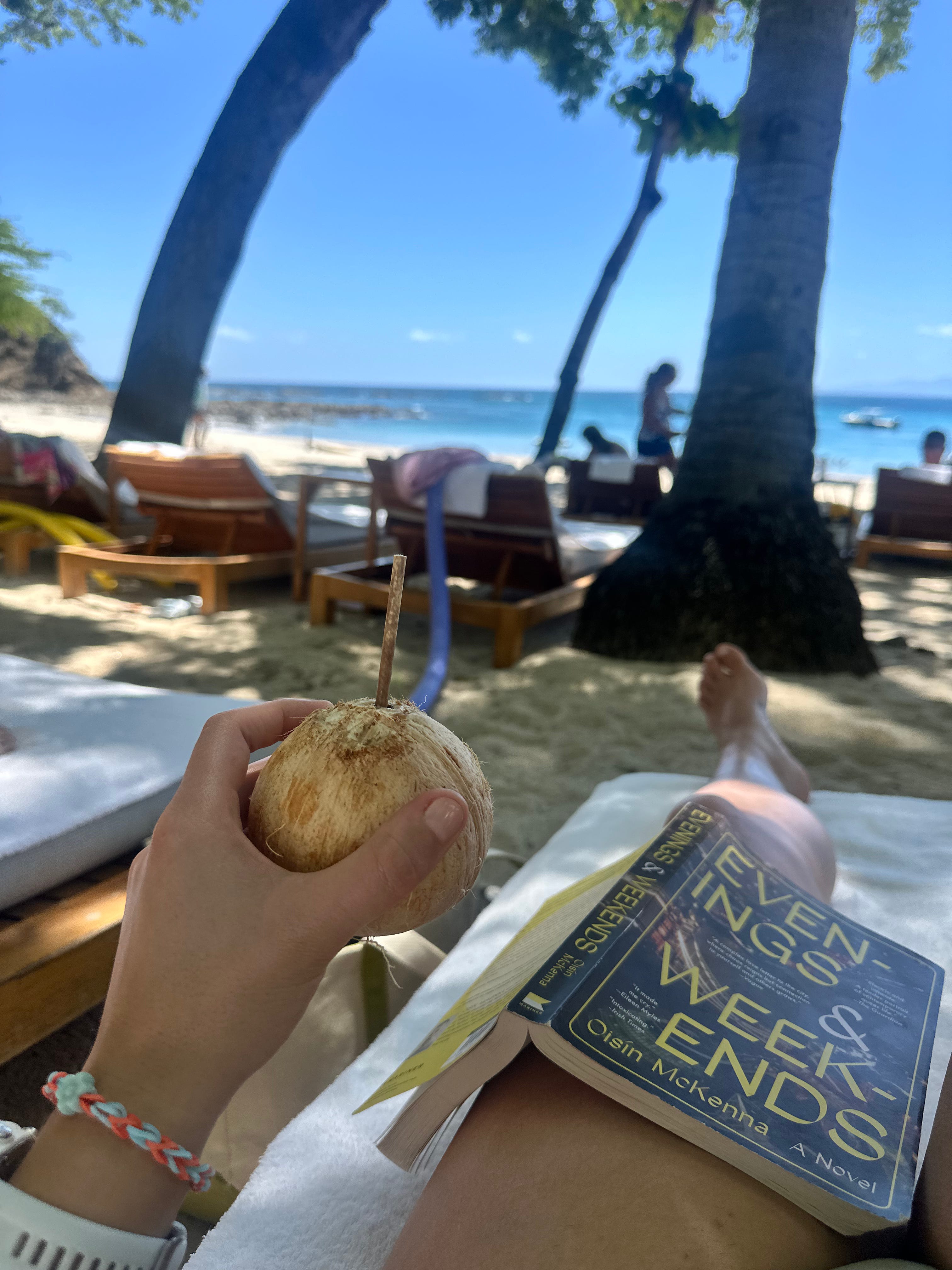
Back on the beach, I tucked into my book: Evening and Weekends by Oisín McKenna. A few chapters in, I understood.
The story unfolds over one sweltering weekend in London, moving in and out of the minds of over half a dozen characters. I loved this time-bounding. The two-day constraint adds claustrophobia that heightens the intensity of the heatwave. And while structurally ambitious, the result left me wanting.
The characters, each painfully self-conscious and self-focused, spend most of the novel marinating in bouts of overthinking. Their insecurity was tedious. Without more to connect to, each reads like an urban-millennial stock character: the pregnant one, the queer-questioning one, the one unsure about polyamory. Even most adults felt one-dimensional, aside from Rosaleen, whose flashbacks to her childhood in Ireland provided a depth beyond her illness.
These vignettes ask readers to empathize solely due to circumstance: a pregnant couple worried about money, a family grappling with cancer, a grieving widow, and people navigating sexuality and desire.
They are rich canvases for a story, but the smorgasbord of stakes paired with thin characters made it difficult to care.
Then, there is the whale stuck in the Thames. A delightfully odd detail from page one that I spent three hundred pages worrying was just a quirky event. In the end, it serves as a central conceit: a creature stranded. Carried to the periphery of its ecosystem by the tides, languishing in London, perhaps worse. It’s a poignant metaphor, but one that could have just as easily been captured with a smaller cast.
I wanted to love this book. I wanted it to succeed. It considers queerness with fresh, spinning prose. The structure explores just how egalitarian a novel can (or cannot) be. These are narrative ingredients I love. Sadly, I left the pages unsatisfied, wishing I could gift every character a session of therapy, and what’s more millennial than that?
Final Thoughts: Gorgeous writing. Ambitious. Fewer characters next time. An author I’m intrigued to keep reading.
Who should read Evenings and Weekends? My M.A. in Literature peeps. Maybe Maggie Nelson fans? It has that “how to queer a novel’s structure” quality that she crushed in The Argonauts. Londoners. Wannabe Londoners. Sally Rooney STANs. Definitely not Katy.